- Annie Wilkes, Part 1: Ford vs. Ferrari: now the subject of one of those Annie Wilkes reviews. "Best left dead", sheesh.
-
The best thing The Federalist has published all year: "Climate Worship Is Nothing More Than Rebranded Paganism". Excerpt:
The reality is, of course, completely different. Much less than destroying the planet, climate change isn’t even a settled science. Conservatives don’t disagree that climate is changing. That is a straw man. Conservatives, however, are opposed to hysteria, have skepticism about the rate of the climate change, and would like to see an actual cost-benefit analysis of the radical changes being demanded.
More important than that, conservatives understand that climate change is cynically used by a certain section of people to justify their political goals of steering the West away from its way of life, a way they perceive to be evil and harmful, hetero-patriarchal, and capitalist. How? Appealing to the faith-based part of human brains, the need for subservience, and propping up children as human shields. - California de facto bans fracking by making all new wells subject to a "scientific" (read: captive of the greens) panel.
- Annie Wilkes, Part 2: Annie Blames The Audience: No, really, Elizabeth Blanks has preemptively blamed men if her Charlie's Angels reboot fails.
She stated, “Look, people have to buy tickets to this movie, too. This movie has to make money.” She added, “If this movie doesn’t make money it reinforces a stereotype in Hollywood that men don’t go see women do action movies.”
This is an odd place to go given recent successes with Wonder Woman, Captain Marvel, and Mad Max: Fury Road. The 2000 reboot took in $125M at the domestic box office, so maybe it's just you, Liz? - Annie Wilkes, Part 3, Corncob Edition:
Wow. Nearly 3000 replies because one woman voices her opinion that we shouldn’t be at a point anymore where we just accept media that normalizes patriarchy. Cool cool cool. Everyone’s having a normal one I see. pic.twitter.com/N8vMHJZ09e— Anita Sarkeesian (@anitasarkeesian) November 21, 2019
- I am glad to see our courts beavering away at the important question of whether women can consent to a threesome. And to think, this poor man almost had his freedom snatched away from him.
- Elizabeth Warren fires the opening shot in banning cars:
Traffic violence kills thousands and injures even more Americans every year. On World Day of Remembrance for Traffic Crash Victims, I'm sending my love to the families and friends of those who have lost loved ones. It's time to #EndTrafficViolence.— Elizabeth Warren (@ewarren) November 17, 2019
- Sully gets it right again on the intersectional left's long-term political goals:
Every now and again, it’s worth thinking about what the intersectional left’s ultimate endgame really is — and here it strikes me as both useful and fair to extrapolate from Kendi’s project. They seem not to genuinely believe in liberalism, liberal democracy, or persuasion. They have no clear foundational devotion to individual rights or freedom of speech. Rather, the ultimate aim seems to be running the entire country by fiat to purge it of racism (and every other intersectional “-ism” and “phobia”, while they’re at it). And they demand “disciplinary tools” by unelected bodies to enforce “a radical reorientation of our consciousness.” There is a word for this kind of politics and this kind of theory when it is fully and completely realized, and it is totalitarian.
Also, homosexuals are now under attack by — wait for it — the woke left, for the crime of not hewing to the trans lobby's worldview:Of course, anyone can and should like whatever they like and do whatever they want to do. But if a gay man doesn’t want to have sex with someone who has a vagina and a lesbian doesn’t want to have sex with someone who has a dick, they are not being transphobic. They’re being — how shall I put this? — gay. When Rich suggests that “it’s not just possible but observable and prevalent to have ‘preferences’ that dog-whistle bigotry,” and he includes in the category of “preferences” not liking the other sex’s genitals, he’s casting a moral pall over gayness itself. Suddenly we’re not just being told homosexuality is “problematic” by the religious right, we’re being told it by the woke left.
- I Am Shocked, Shocked That Mothers Want To Be With Their Children, but this apparently is huge news to the New York Times. A study of California, which in 2004 instituted mandatory paid maternity leave, found women worked fewer hours and earned less a decade later, results that are consistent with the results in Sweden, where the labor pool is the most sex-segregated in the OECD.
Showing posts with label wage gap. Show all posts
Showing posts with label wage gap. Show all posts
Friday, November 22, 2019
More Link Dumping

Monday, January 7, 2019
More Obvious Stuff On Sexual Attraction And Marriage
- "Why Aren't More Wives Outearning Their Husbands?" asks Derek Thompson in The Atlantic. The distribution of the wife's share of income has a hard break around 50%, as shown here, with a significant disparity on the right side. This is not a normal distribution (emboldening mine):

This drop-off is simply too steep to be explained by randomness or classical economics. If men and women were forming marriages without concern for relative incomes, we'd expect a smoother distribution curve...
The assumption that women have nothing to do with these choices is a peculiar one, especially considering the next item...
In a cool new paper, Marianne Bertrand, Jessica Pan, and Emir Kamenica pose a theory that some people might find controversial but others might find intuitive: What if there's a deficit of marriages where the wife is the top earner because -- to put things bluntly -- husbands hate being out-earned by their wives, and wives hate living with husbands who resent them?
If this were true, we would expect to see at leastthreefour other things to be true. First, we'd expect marriages with female breadwinners to be surprisingly rare. Second, we'd expect them to produce unhappier marriages. Third, we might expect these women to cut back on hours, do more household [chores], or make other gestures to make their husbands feel better. Fourth, we'd expect these marriages to end more in divorce. Lo and behold (as you no doubt guessed), the economists found all of those assumptions borne out by the evidence. - "Different impacts of resources on opposite sex ratings of physical attractiveness by males and females", Guanlin Wang, et al., Evolution and Human Behavior, March, 2018, pp. 220-225. Abstract:
Parental investment hypotheses regarding mate selection suggest that human males should seek partners featured by youth and high fertility. However, females should be more sensitive to resources that can be invested on themselves and their offspring. Previous studies indicate that economic status is indeed important in male attractiveness. However, no previous study has quantified and compared the impact of equivalent resources on male and female attractiveness. Annual salary is a direct way to evaluate economic status. Here, we combined images of male and female body shape with information on annual salary to elucidate the influence of economic status on the attractiveness ratings by opposite sex raters in American, Chinese and European populations. We found that ratings of attractiveness were around 1000 times more sensitive to salary for females rating males, compared to males rating females. These results indicate that higher economic status can offset lower physical attractiveness in men much more easily than in women. Neither raters' BMI nor age influenced this effect for females rating male attractiveness. This difference explains many features of human mating behavior and may pose a barrier for male engagement in low-consumption lifestyles.

Wednesday, January 2, 2019
Being Links I Found Interesting
- The NYT Fails Sexual Units Reduction: Of course this NYT piece focusing on activities smartphones keep people from doing has some spectacularly crazy numbers, but what everyone keeps talking about is the claimed 16,000 times you might engage in sex over the course of a year. This is based on a lovemaking session lasting 5.4 minutes (5:24), which seems terribly ... brief. Some math:
16,000 sex events/year * year/365 days * 24 hours/day/16 waking hours/day * day/1,440 min = 1 sex event/22.9 min
That, of course, is a prodigious pace for any man. The human post-coital refractory period averages around a half hour for men, with younger men having times around 15 minutes, and men in their 70s around 20 hours. A gifted few are capable of zero-duration times, but such superhuman feats require a Hugh Hefner at his peak level of dedication to the task. (Women may or may not have such a period, but it seems unlikely they would engage in such extended bouts.) - Godfrey Elfwick is back!
- New Jersey, New York, and Illinois are the top three states people are moving away from, per United Van Lines' annual survey. Vermont, Oregon, and Idaho are the top three inbound.
- "Achievement motivation" may explain part of the gender wage gap, but only a small (5%) part.
- Women's marches in Eureka, CA and New Orleans have been canceled, the former because 80% white Eureka has too many white people marching. A long-form article at Tablet suggests the real problem is funding.
Sunday, December 30, 2018
The New Feminist Woman Isn't On The Scene Yet: Marriage, Divorce, And Income
- Married Men Outearn Single Men And Women As A Whole (St. Louis Fed Study). Translated, women are pretty comfortable letting their mates bring home the bux, and are good at choosing ones who can.
- Men Without Full-Time Jobs Are 33% More Likely To Divorce. Highlights:
- "Two thirds of divorces are initiated by women, even though their chances of remarrying are slimmer than their ex-spouses’.
- "These days guys who have jobs have a predicted divorce probability in the next year of 2.5%, whereas the same guys who do not have a probability of 3.3%."
Thursday, November 29, 2018
The Grievance Miners Expand The Wage Gap
The strip-miners of grievance have come up with yet another garbage "study" purporting to find an even bigger wage gap than had previously been reported, the bogus 80-cents-on-the-dollar having been multiply debunked (also all these). At first, we get the sense that The Atlantic's Annie Lowrey will treat this tendentious trash with the disdain it merits:
Comparing apples to apples and oranges to oranges, women earn close to what men earn: Women in similar workplaces with similar titles and similar credentials make pretty much what their male peers do, whether they are fast-food employees making close to the minimum wage or corporate executives making hundreds of thousands of dollars a year. This has led some publications to argue that the pay gap is far smaller than generally understood, and yet others to argue that the pay gap is a myth.Oh, but we can't have that, so then, the backhand return:
This splicing of the data has its own serious shortcomings, though. Study after study has shown that women do not get equal pay for equal work, nor do they have access to equal work. Women struggle to get hired and to ascend the corporate ladder; in one study, men were promoted at a rate 2.2 to 3 percentage points higher than women. When women surge into a given field, pay in that field tends to drop, as if women were some kind of industry-wide reputational pollutant. The bulk of the evidence shows that women earn less, in part because of discrimination.Imagine, employers paying less for employees who spend less time on the job, who aren't willing to devote themselves to their employers. But it actually gets worse, if this is possible: reading the text of this "study" (PDF), the authors rapidly show their colors in just the highlights of their methodology:
Moreover, women’s employment patterns are different from men’s, Rose, a labor economist at the Urban Institute, told me. They are less likely to work full-time and to spend years-long, uninterrupted stretches in the labor force. They are more likely to have to take time off to have a child, or to have to work part-time in order to care for family members.
When measured by total earnings across the most recent 15 years for all workers who worked in at least one year, women workers’ earnings were 49 percent—less than half—of men’s earnings, a wage gap of 51 percent in 2015.So if a woman worked one year of fifteen, her earnings were piled up against a man who had worked all fifteen of them. That would include men who worked overtime, men who had continuous employment during that time. So of course they found women brought home less money. Could anything be more absurd?
Thursday, September 6, 2018
Shooting The Messenger On Part-Time Female Physicians
Tell the truth these days (or come close to it) and your assured destruction at the hands of the feminist lynch mob will soon ensue. Take Dr. Gary Tigges, M.D., P.A., who recently said of the alleged gender gap in pay among physicians,
Previously: The Crisis of Part-Time Physicians
Yes, there is a pay gap. Female physicians do not work as hard and do not see as many patients as male physicians. This is because they choose to, or they simply don’t want to be rushed, or they don’t want to work the long hours. Most of the time, their priority is something else … family, social, whatever.Of course, this yielded a pointless apology from him, a dumb parody piece (uncharacteristically) from Gomerblog — and the usual horrified objections disconnected from any actual rebuttal. Take this one from the American Council of Science and Health, by Jamie Wells, M.D. Mostly indignant offense-taking, she finally settles down to marshal something resembling an argument. And by "resembling", I mean just that, because it isn't much of one. For instance:
Nothing needs to be “done” about this unless female physicians actually want to work harder and put in the hours. If not, they should be paid less. That is fair.
Dr. Tigges' misguided statements, out of step with more than a decade of data that disputes his biased assertions demonstrating that female physicians are not only as good as their male counterparts but in many instances provide higher quality care with better outcomes, are commonly held beliefs throughout the healthcare system, particularly by those in management and administrative roles (see here and here).But wasn't the issue compensation due to time spent in patient care, not administrators and managers? Okay, let's keep going. Maybe she provides something of substance anon.
Another example that is standard fare for those subscribing to the Tigges way of thinking is that more women physicians work part-time. The reasons for this are often mischaracterized as "their choice." This is often not the case. Practices don't have to cover benefits or pay as much for part-time, so they offer it instead which uniformly results in full-time work for part-time pay. Changing jobs or accepting the reality of seeing more for less until something better comes is a mainstay dilemma for countless women.This word salad rebuts not at all Tigges' assertion that women see fewer patients. Perhaps it is not their fault. But so what? Earlier, she complains of "the perverse payment incentives of the RVU (relative value unit) system here which values low quality, high volume patient mill type medical practice." All these things may be true. But, again, they do not form a counterargument. At last, she drags out the big guns, from something called Equity Quotient. There, we learn
At last, an on-point citation with numbers! Unfortunately for Equity Quotient and Dr. Wells, the underlying 2016 Wall Street Journal story buttresses Dr. Tigges' assertion, not hers. The devil is in the details (paywall, emboldening mine):
- Of 446 major U.S. occupations, physicians have largest median gender-based pay gaps; in some subspecialties, as much as $90k (Wall Street Journal 2016)
- Over $9,000 per physician/per year is spent by healthcare organizations due to gender inequality — cost accrued from attrition, burnout and litigation (discrimination/sexual harassment).
- Total cost of recruitment, on-boarding, lost revenue, about $400k (up to $600k) for a single hospitalist
The biggest gaps in many white-collar professions don’t easily lend themselves to legislative remedies. In fact, the Journal’s findings belie policy makers’ hope that the most-educated women would lead the way in shrinking the gap. Currently, more women than men graduate from college.What those "workplace cultures" are, the unnamed researchers don't say later in the article, but one suspects it has to do with the expectation of long hours, among other things. As with the overall and principally bogus "pay gap", hours, continuity, and specialization produce higher returns. A multivariate analysis based on specialty, time spent on the job, and continuity of employment would be useful. Too bad we don't appear to have it.
Wage transparency—requiring employers to report salary data—is “just not going to move the needle much,” says Claudia Goldin, a Harvard University economics professor and one of the country’s foremost scholars on gender and pay. Prof. Goldin found in a 2010 paper that men and women earned almost the same salaries right after receiving University of Chicago M.B.A.s. At least a decade after graduating, the women earned 57% of their male classmates.
The main factor, she and her co-authors concluded: Women became mothers, interrupted their careers and eschewed lengthy hours that generated higher paychecks. “These particular occupations,” Prof. Goldin says, “are not very forgiving of taking time off and having kids.”
The Journal’s analysis of Census Bureau data for the five years through 2014 found male doctors working full time earned about $210,000 annually on average. Female physicians made 64% of that, about $135,000 a year. Among personal financial advisers, men took in about $100,000 while women made about $62,000.
Many white-collar jobs give substantially larger financial rewards to those logging the longest hours and who job-hop often, phenomena that limit white-collar women who pull back for child-rearing. Researchers on the topic say ingrained workplace cultures also impede women’s earnings.
Previously: The Crisis of Part-Time Physicians
Thursday, January 4, 2018
Equality's Asymptotes: The Self-Licking Ice Cream Cone Of The Gender Wage Gap
The American Association of University Women has a surprisingly good study of the gender wage gap which breaks down the disparity in a number of ways, but I wanted to focus particularly on this graph:
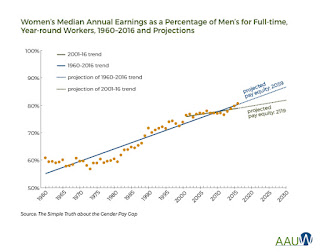 What's most interesting is the aggregate earnings gap (which is what is generally discussed, without diving down into specifics) from 2001-2016. The gap is on a long-term diminishing trend since 1960, but that longer-term regression line is on a steeper slope than more recent decades. That is, change is slowing down. While a lot of this report spins its wheels with the usual intersectional nonsense that adds nothing to the discussion, knowing that we have reached or can project some kind of possible upper limit of what women collectively are liable to do in the labor marketplace is valuable. Women do not sign up for STEM careers generally (engineering and computer science particularly) that pay better than a lot of other degreed careers. They take time off from careers for motherhood, further pressing down on wages. The refusal to deal with these kinds of crucial details hasn't deterred the wage gap vooodooists, who believe absolute numerical gender parity is not only possible but desirable. Never mind that women themselves prefer to marry men with higher incomes than they earn, and demonstrably place a higher value on male earning power than any other single polled trait of either sex. The wage gap may narrow, but it will never vanish — precisely because women reward men for maintaining it.

Monday, February 6, 2017
Audi's Wage Gap Pratfall
I've treated the mythical "wage gap" multiple times before, but yesterday's Audi ad during the Superbowl was a sort of tour de force of unrepentant cant:
Of course, with an organization as large as Audi, it's almost impossible to keep everyone within the organization on message:
You've gotta wonder about ends of the organization that came to such wildly differing conclusions about the role and pay of women in the workforce. What are they saying with that film? That everyone else in society is the bad guys, but Audi isn't one of them? Oh, and, do these faces look terribly female to you? (Notwithstanding Jeri Ward, who was presumably in charge of this fiasco, and HR director Christine Gaspar.) The story about how this ad came to be made would be an interesting one, and is lightly touched upon in an Ad Age piece issued contemporaneously with its release:
Keeping everyone on the same page is a tough thing, especially as your company gets larger. This disjoint fiasco shows why.
Of course, with an organization as large as Audi, it's almost impossible to keep everyone within the organization on message:
@Audi You pay your female employees less than males? You know that's against the law, right?— Prepper Frog (@TueborFrog) February 1, 2017
@TueborFrog When we account for all the various factors that go into pay, women at Audi are on par with their male counterparts.
— Audi (@Audi) February 1, 2017
You've gotta wonder about ends of the organization that came to such wildly differing conclusions about the role and pay of women in the workforce. What are they saying with that film? That everyone else in society is the bad guys, but Audi isn't one of them? Oh, and, do these faces look terribly female to you? (Notwithstanding Jeri Ward, who was presumably in charge of this fiasco, and HR director Christine Gaspar.) The story about how this ad came to be made would be an interesting one, and is lightly touched upon in an Ad Age piece issued contemporaneously with its release:
What is notable about Audi's spot is that it was directed by a woman -- Aoife McArdle, a top director repped out of Somesuch and Anonymous Content who has directed big-brand work for the likes of P&G (Secret), Under Armour, Honda and Samsung. Last year, Ms. McArdle directed a spot for Secret that also carried an equal pay message.Previously, the Ad Age story mentions a "Free The Bid" initiative to address the lack of women in the field, but it takes with it the cast that women are in need of special protection from the same environmental hazards men are, i.e. it perpetuates women as "damsels in distress".
Gender inequity remains a huge issue in the ad production business. Women comprised only 9.7% of the rostered directors of the production companies that made Ad Age and Creativity's Production Company A-List in 2015, according to an analysis Mashable did of the list for a story published last year.
Keeping everyone on the same page is a tough thing, especially as your company gets larger. This disjoint fiasco shows why.
Thursday, May 12, 2016
Commercial Feminism Watch, #2 In A Series: The Wage Gap Whisperers
I have previously written about "commercial feminism", a locution apparently originated by game developer Chihiro Onitsuka. An enterprising branch seeking sinecures beyond the usual strongholds in academia and the feminist press, the latest efforts focus on shaming progressive-leaning Silicon Valley into more diversity hires, and more importantly, increased bureaucracy. Shanley Kane is on it, of course, as well as those selling software to stockpile psycho, but the field seems ripe for expansion. The veins of guilt infusing white liberals seem to know no limit, and are therefore a resource waiting for the miner's pick. I caught wind of one such scheme today:
Ken Abosch spends his days digging into financial accounts and numbers that most companies don’t want their employees knowing about — namely, how much you get paid compared with your colleagues. But he’s actually part of a team of data-loving whizzes at the consulting firm Aon Hewitt who get multiple calls a week asking for help to fix issues with pay gaps. “It’s like the doctor who sees patients who are mostly ill,” says Abosch, Aon’s North American compensation practice leader, “because the majority of clients we assist do have some issues that need to be addressed.”Feeding as it does the impulses both to atone for success and to parade and reward envy, the major surprise here is that such wizards had not been on the scene earlier. One wonders, of course, who pays the salary of someone with the nebulous title of "Director of Equity Research and Shareholder Engagement", and more importantly, why, especially given the convincing evidence of the wage's gap almost entirely spectral nature, a product of women's own choices. You will seek in vain any mention of actual performance from Arjuna Capital; that, apparently, is not a concern of theirs, which luckily makes their game self-limiting.
Call ’em the salary whisperers of America. While that’s not their official job title, for Abosch and thousands of other internal auditors across the country, it may as well be. Their so-called pay audits have gained in popularity in the past couple of years as more companies — especially those in the tech sector — take financial information that used to be kept secret and make some of it public. We’re talking about revealing pay gaps for women, minority employees and the average worker whose pay slips pale in comparison to their executive bosses. And this trend for exposing salaries has ushered in a new era of transparency, pushing some companies toward a pledge of equal pay.
Saturday, October 24, 2015
Speculation On Modern Feminism And Feminists
A response to an Amy Alkon blog post regarding an Emily Hill essay on modern feminism that Ms. Alkon's commenting system ate, which I wanted to preserve owing to length:
Modern feminism is totalitarian and expansionist, albeit the latter not in the typical sense one thinks of when discussing political ideologies. Instead, its adherents seek ever-smaller microaggressions to police (nanoaggressions? picoaggressions?). There's some evidence that self-described feminists are in numerical decline, perhaps a consequence of the cognitive dissonance that exists in the gap of defining feminism as simple equality between the sexes, and real-world proposals offered up by its adherents (e.g. affirmative consent laws, bogus rape statistics, wooly-headed wage gaps, and the conspiracy theories of "rape culture" and "patriarchy").
Such a feminism seems so obviously idiotic it should be self-extinguishing within a generation or so; it's hard to imagine a majority of women are that dumb. Yet Jezebel and other smaller feminist media outlets steam on, which proves they have a readership broad enough. My theory, untroubled by data or research in the matter, is that modern feminism draws from two reservoirs of support, one small, one large:
Update: Apparently a hidden condition of Alkon's commenting system relegated this to the spam folder. An earlier version of this is now up, but the remarks above are refined a bit from that earlier effort.
Modern feminism is totalitarian and expansionist, albeit the latter not in the typical sense one thinks of when discussing political ideologies. Instead, its adherents seek ever-smaller microaggressions to police (nanoaggressions? picoaggressions?). There's some evidence that self-described feminists are in numerical decline, perhaps a consequence of the cognitive dissonance that exists in the gap of defining feminism as simple equality between the sexes, and real-world proposals offered up by its adherents (e.g. affirmative consent laws, bogus rape statistics, wooly-headed wage gaps, and the conspiracy theories of "rape culture" and "patriarchy").
Such a feminism seems so obviously idiotic it should be self-extinguishing within a generation or so; it's hard to imagine a majority of women are that dumb. Yet Jezebel and other smaller feminist media outlets steam on, which proves they have a readership broad enough. My theory, untroubled by data or research in the matter, is that modern feminism draws from two reservoirs of support, one small, one large:
- Lesbian separatists and other deeply disaffected women, who staff the academic walls of womens' studies departments and provide the bulk of feminist theory. They are, necessarily, a small subgroup.
- Lay feminists in the world outside the academy, who are probably overall less extreme in their prescriptions but not necessarily in their ardor for what they perceive the cause to be. Among them, especially among younger women, is a large contingent of only children, daughters of comparative privilege who had little intimate contact with boys as peers (or near peers) at a young age, and thus lack empathy and understanding for them.
Update: Apparently a hidden condition of Alkon's commenting system relegated this to the spam folder. An earlier version of this is now up, but the remarks above are refined a bit from that earlier effort.
Thursday, September 3, 2015
A Histamine Reaction To Choice
Meagan Tyler gripes about "choice feminism" because it doesn't comport with her vision of what feminism is or ought to be, and then:
First of all, the choice arguments are fundamentally flawed because they assume a level of unmitigated freedom for women that simply doesn’t exist. Yes, we make choices, but these are shaped and constrained by the unequal conditions in which we live. It would only make sense to uncritically celebrate choice in a post-patriarchal world.Since the religious tenet of "patriarchy" cannot be measured, it also cannot be dispelled or dispatched.
Second, the idea that more choices automatically equate to more freedom is a falsehood. This is essentially just selling neo-liberalism with a feminist twist. Yes, women can now work or stay at home if they have children, for example, but this “choice” is fairly hollow when child-rearing continues to be constructed as “women’s work”, there is insufficient state support for childcare, and childless women are decried as selfish.The idea that women might choose to be mothers and homemakers is apparently lost on her, but it is evident in the Swedish labor market, where women — with enormous paid maternity benefits — nevertheless elect to remove themselves from higher-paying positions in favor of jobs with more schedule flexibility. And if she's waiting for everyone to agree with her choices, guess what: that's not gonna happen, either, just as she disagrees with a lot of other women's choices. (But apparently it's okay when she does it.) It turns out her big problem with "choice feminism" is that it's not Marxist enough:
It doesn’t demand significant social change, and it effectively undermines calls for collective action. Basically, it asks nothing of you and delivers nothing in return.The first sentence is true, the second false. Collective action won't address women who don't go into STEM careers, who decide to become mothers and drop out of the labor market, thus pulling down overall female wages earned and contributing to the bogus "wage gap". "Social change" in this context demands special treatment for women, and only women; choice feminism says women need to be grownups and own their lives and the choices made therein. Blaming "society" for every bad thing infantilizes women, claiming they can't change anything unless everyone agrees to their utopian worldview. Imagine, for instance, Nellie Bly or Amelia Earhart subscribing to that nonsense; it's impossible. Ayn Rand said, “The question isn't who is going to let me; it's who is going to stop me.” The modern feminist says, "I can't, because all these people might stop me."
Sunday, August 30, 2015
Randal Olson Takes A Close Look At The Wage Gap
Randal Olson, whose work I have previously admired, is back today (h/t Christina Hoff Sommers) with a look at the wage gap between the sexes, and in particular, how this is affected by college majors. Starting with a FiveThirtyEight post about remuneration for college majors, he then proceeds to dig through major-specific data (for a change, emboldening is all his):

The trend that’s immediately apparent from this chart is that female-dominated majors make less on average than male-dominated majors. Some interesting exceptions to the trend are Nursing (90% women; $48k median earnings) and Transportation Science (12% women; $35k median earnings), where Nursing especially stands out as a relatively lucrative major despite being primarily women.Unsurprisingly, after controlling for un- and under-employment, he looks at quantitative SAT scores and finds a strong correlation between that and earnings, i.e. the kinds of jobs that require analytical skills and compensation to match. His takeaways:
At least when dealing with the opposite sex, men have a strong incentive to find gainful, and in particular, remunerative employment: 78% of women in a recent Pew poll said they want a man with "a steady job", which was more than any other aspect desired in a potential mate by either sex. If feminism has shaped a new model woman exactly like men in every way, she has not manifested herself in the broad population as yet.
- Female-dominated majors tend to earn less than male-dominated majors
- This correlation isn’t explained by the employability of the majors
- It seems plausible that male-dominated majors are usually paid more because they are more quantitative in nature, which large companies tend to value highly
Sunday, December 21, 2014
The Cult Of Ada Lovelace
Somehow I managed to avoid talking about "The Problem With “We Need More Women In —”", which is really surprising considering it addresses a longstanding bête noir of mine, the endless, and thus far, largely fruitless quest to get more women into the science, technology, engineering, and mathematics fields (STEM, commonly). Her solution is to acknowledge the reality, but declare it a non-problem:

From shortly after I entered college in 1981, the trend line in female CS grads has gone nowhere but down as a percentage of overall graduates. And this despite no small amount of foment trying to get girls interested in the topic. What is utterly puzzling about this: if, as the author notes, some 90% of registered nurses are female, why aren't feminists agitating to equalize that field, or veterinarians, which produced 78% female graduates in the most recent year reported (2012), according to the AVMA (PDF)? And while this is pure speculation, my suspicion lies in the direction that
One of the great counterarguments to the nonsensical trope that women make 70% of the wages of men is that if it were true, why aren't employers flocking to female employees in order to extract that 30% discount labor? And the answers, while complex, all come back to
I do not believe women should be sought out for jobs that are publicly posted if there are already qualified candidates interested. If you believe this should be the case, then you are promoting bias and discrimination on the basis of nothing but gender. You are more interested in the demographic breakdown of an industry/company/area of research than the quality of work, or employee, involved in said area. I believe that, by actively seeking out women to fill a certain percentage of a specific field, you are not only turning women into tokens, you are promoting a very troubling belief that they should expect special treatment and consideration for just being women. In addition, you are teaching girls and young women that, no matter what, they will be viewed by their gender first, and all else will be secondary. A troubling and heartbreaking side effect of this is that the same will happen with boys and young men, although the outcome will be much less pleasant for them.This situation —which has existed my entire adult life — has been fought with a number of tools over time, the most prominent being the finding of suitable female role models. Ada Lovelace (arguably the first programmer) and Adm. Grace Hopper (creator of the despicable but important COBOL language, and originator of the locution "bug" in the sense of "unintended flaw") are two of the most commonly cited, with Lovelace even getting a (terrible) language named after her. Largely, all this effort hasn't helped, and over time, computer science in particular has suffered a significant decline in female graduates:
From shortly after I entered college in 1981, the trend line in female CS grads has gone nowhere but down as a percentage of overall graduates. And this despite no small amount of foment trying to get girls interested in the topic. What is utterly puzzling about this: if, as the author notes, some 90% of registered nurses are female, why aren't feminists agitating to equalize that field, or veterinarians, which produced 78% female graduates in the most recent year reported (2012), according to the AVMA (PDF)? And while this is pure speculation, my suspicion lies in the direction that
- Women must do important things in society.
- Science is important.
- Therefore, women must be scientists.
Too anecdotal? OK: here’s a 2008 Harvard Business Review research report (PDF) on women in science, engineering, and technology, which found:If you actually drill down to the Harvard Business Review study, you'll realize quickly that it's nothing more than airy assertions piled on feminist cant, multiplied by mewling that women shouldn't have to work as hard as men to get the same recognition. Example:
Between ages 25 and 30, 41% of the young talent with credentials in those subject matters are female … [but] 52% of this talent drops out … The most important antigen is the machismo that continues to permeate these work environments … 63% of women in science, engineering and technology have experienced sexual harassment.I haven’t found any comparable studies from the last five years, but you’d be hard pressed to find anyone who thinks things have gotten much better since 2008 — until, maybe, just this last year, when more people seem to have become willing to at least discuss the issue. As long as you don’t suggest it’s anything more than a pipeline problem.
But guess what? If you create an environment wherein a whole class of entrepreneurs and employees goes unnoticed by deeply flawed industry-wide “pattern recognition” heuristics, and/or one where they have to be perpetually on their guard, and must pretend not to notice all the myriad microaggressions that make them feel vulnerable and uncomfortable and out-of-place…
In some industries, this hard hat culture is known as a “firefighter” culture, where the most admired individual at the plant is the larger-than-life male who runs around dealing with various emergencies—putting out actual and proverbial fires.How terrible — having to actually be competent under stress. Another:
Tech women talked about the “diving catch” behavior that is center stage at technology companies. Alpha male techies come to the rescue—zooming in at the eleventh hour like Superman or the Lone Ranger to save a system that is threatening to crash. Women find it extremely difficult to take the kinds of risks involved in making these saves—their buddy system just isn’t strong enough to save them if they were to fail. They resent the fact that making a diving catch is often the only way to get promoted at a tech company.Demonstrating that you can get the job done under pressure — well, we can't have that now, can we? Feminists demanding more women in STEM fields are all too eager employ the kind of infantilization that women must be treated with kid gloves vs. men in the same area.
One of the great counterarguments to the nonsensical trope that women make 70% of the wages of men is that if it were true, why aren't employers flocking to female employees in order to extract that 30% discount labor? And the answers, while complex, all come back to
- Employees are not all the same.
- The ones who get the job done despite long hours are more valuable.
Economists Eric Solberg and Teresa Laughlin applied an index of total compensation, which accounts for both wages and benefits, to analyze how these benefits would affect the gender gap. They found a gender gap in wages of approximately 13 percent. But when they considered total compensation, the gender gap dropped to 3.6 percent.And here you might say, well, this is a tangent. No, no it's not, because this is really about recognizing women's choices have consequences. The advocates for "we must get more women in STEM careers" refuse to acknowledge those choices. Feminism, apparently, only gives women as much autonomy as aligns with the party goals for them; other choices, raising children, maintaining a household, spending time with their families, are simply Not Allowed.
Subscribe to:
Posts (Atom)